

As work itself is reshaped by AI and shifting business demands, skills-based organization design gives leaders a more accurate and more actionable picture of their workforce.
By Jillian Ogawa, Head of Content Marketing, Censia | Article Published: April 13, 2026
At a glance:
- Skills reveal more than titles can: Mapping capabilities across the workforce lets organizations move talent based on what people can actually do, creating deployment flexibility that job-based structures don’t support.
- AI value depends on workflow redesign: McKinsey argues that organizations capture more value when they redesign workflows around AI, not when they treat AI as a set of isolated tools or pilots.
- Visibility changes the decisions leaders can make: When capability is explicit rather than inferred, internal mobility and workforce planning become more precise and more strategically useful for the business.
A skills-based organization structures work around what people can do, not what their job title says they should do. Rather than organizing talent into fixed roles and hierarchies, it maps capabilities directly to work: who has what skills, which tasks those skills enable, and how both can be deployed more deliberately as business needs shift. For most senior leaders, this isn’t a radical departure from how high-performing teams already operate. It’s a formalization of what good managers have always done informally, built into an infrastructure that makes it possible at scale.
The pressure to shift is real and measurable. According to the World Economic Forum’s Future of Jobs Report 2025, 39% of core skills will change by 2030, with 170 million new roles emerging even as 92 million existing ones are displaced. Job titles have always been imprecise proxies for capability, and they are becoming even less useful as guides for deploying talent effectively.
Why Does a Skills-Based Organization Outperform a Job-Based One?
Job-based structures optimize for predictability. They assume that what someone did yesterday reliably indicates what they should do tomorrow, and that roles are stable enough to hire and develop against over multi-year horizons. That assumption is under significant pressure.
The scale of change is not incremental. McKinsey’s research on the agentic organization finds that 75% of current roles will need reshaping, as AI becomes embedded across workflows. Organizations planning around fixed roles are effectively optimizing for a structure that will need to be rebuilt within a single planning cycle.
Skills-based organizations address this by maintaining a living picture of capability: what people can do, what they’re building toward, and where adjacent skills exist that could be directed toward emerging needs. This creates optionality that job-based structures simply don’t have.
Key takeaway: Skills-based structures create deployment optionality because they track what people can do, not just what they’ve been hired to do. That distinction becomes decisive when roles are changing faster than org charts can keep up.
What Does Redesigning Work Around Skills Actually Involve?
Work redesign isn’t a matter of relabeling roles. It requires decomposing work into tasks, mapping those tasks to the capabilities that execute them, and building systems that surface the right people for the right work regardless of where they sit in the org chart.
The business case for doing this is direct. McKinsey’s work on reconfiguring work for the AI era suggests that the biggest gains from AI come not from isolated use cases, but from redesigning work itself. Although 90% of companies report investing in AI, fewer than 40% report meaningful bottom-line impact, because many are still applying AI to individual tasks rather than rethinking end-to-end workflows. The organizations capturing the most value from AI aren’t just deploying tools; they’re changing how work is structured around those tools. Skills-based organization design is the enabling architecture.
Practically, this means HR and workforce planning leaders need to answer several interconnected questions: Which tasks are stable enough to hire against, and which are likely to be reshaped by automation? Where do skill concentrations exist that aren’t visible through the current role structure? What adjacent capabilities could be developed or redeployed to address emerging needs?
These questions require data that most job-based HR systems weren’t built to provide. Surfacing that data manually, at enterprise scale, is precisely where the approach breaks down.
Where Skills Architecture Creates Strategic Leverage
The infrastructure supporting this model is typically called skills architecture, which is the structured mapping of capabilities across a workforce. The practice is growing: Mercer’s 2025/2026 Skills Snapshot Survey found that 38% of organizations now maintain an enterprise-wide skills library, up significantly from two years prior, and 55% are actively mapping skills to jobs. The momentum is clear. The gap between having a skills library and acting on it at scale, however, remains significant for most organizations. Closing that gap requires AI that can infer skills from existing workforce data, keep those profiles current without manual input, and surface the right people when decisions need to be made. That is the capability Censia AI was built to deliver.
Skills architecture changes what decision-makers can see. Instead of headcount by role, leaders gain visibility into capability distribution across the organization: where strengths concentrate, where gaps are forming, and where internal talent could address needs that would otherwise require external hiring. Deloitte describes workforce planning as shifting toward work-task planning, and reports that 93% of respondents believe moving away from the job construct is important to organizational success. It also notes that skills-based planning enables more precise talent gap analysis and worker redeployment as needs change.
What Makes Skills Architecture Operable at Scale
Building this model at scale requires dedicated infrastructure: specifically, the ability to infer, map, and act on skills data across a workforce that may number in the thousands. Manual skills assessments don’t scale. Self-reported profiles don’t stay current. What’s needed is a system that generates a dynamic picture of organizational capability and updates it as work evolves.
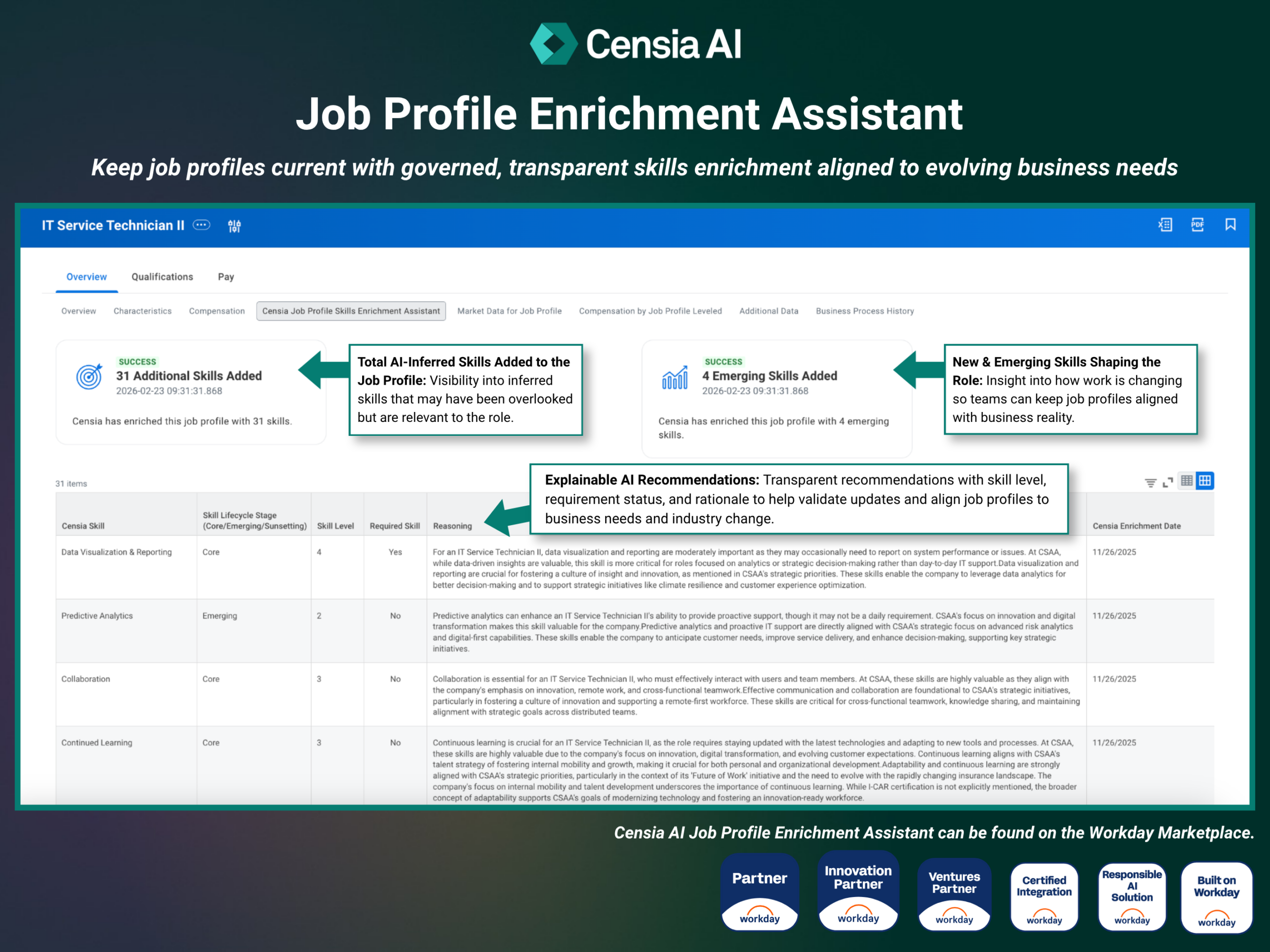
Censia AI is purpose-built for exactly this infrastructure gap. Its AI models are trained on nearly a decade of workforce data spanning professional history, role transitions, and skills demand patterns across thousands of data points, and they infer capabilities from that data without requiring employees to fill out a single survey or self-assessment. Profiles are enriched automatically and kept current as work evolves. For organizations running Workday, Censia works natively within Workday Skills Cloud, writing enriched skills data directly back into existing employee profiles, so the intelligence is embedded in the system of record rather than sitting in a separate tool. The result is the internal mobility the skills-based model depends on: when leaders can see what their workforce is capable of rather than relying on what titles suggest, they can deploy talent more deliberately and develop people along paths aligned to both organizational need and individual capability.
What Changes When You Organize Around Skills?
The most immediate change is visibility. Job-based structures make capability inference necessary: you look at a title and extrapolate what someone can do. Skills-based structures make capability explicit, which changes how decisions about deployment, development, and hiring get made.
The performance gap between organizations that make this shift and those that don’t is already showing up in the data. KPMG’s AI Quarterly Pulse Survey finds that 87% of leaders now see upskilling the workforce as a key priority, yet 62% still say employee skill gaps are limiting AI ROI. Skills architecture is part of what closes that gap. It creates the organizational conditions in which AI tools can be deployed effectively and workforce capability can keep pace with what those tools enable.
This isn’t just a technology story. It’s an infrastructure story. KPMG’s research shows that even as organizations prioritize workforce upskilling, skill gaps still hold back AI ROI. The organizations capturing real value from AI aren’t simply doing more with the technology. They’re building the workforce foundation that makes AI useful, actionable, and scalable. Skills architecture is that foundation. The shift from job titles to skills is how you build it. For organizations ready to move from intention to infrastructure, Censia AI can help you get there.
Key takeaway: KPMG finds that 87% of leaders see workforce upskilling as a priority, while 62% say skill gaps are holding back AI ROI. The differentiator isn’t just the AI. It’s the workforce infrastructure underneath it.
FAQ: FREQUENTLY ASKED QUESTIONS
What is a skills-based organization?
A skills-based organization is one that structures work and deploys talent based on capabilities rather than job titles. Instead of assigning people to fixed roles, it maps skills to tasks and surfaces the right people for the right work based on what they can actually do. This creates greater deployment flexibility and allows workforce planning to keep pace with how work is changing.
What is the difference between a skills-based organization and a traditional job-based structure?
A traditional job-based structure organizes talent around defined roles with fixed responsibilities. A skills-based organization organizes talent around capabilities, mapping what people can do to what work requires regardless of job title. Deloitte describes this evolution as moving from job-based planning to work-task planning, where decisions are driven by capability requirements rather than org chart position.
Why are organizations shifting to skills-based models?
The primary driver is the pace at which AI is reshaping work. The World Economic Forum projects that 39% of core skills will change by 2030, making job titles an increasingly unreliable proxy for what people can do. Organizations that plan around fixed roles are optimizing for a structure that will need to be rebuilt within a single planning cycle.
What is skills architecture?
Skills architecture is the structured mapping of capabilities across a workforce, connecting what people can do to what work requires. It is the data layer that makes workforce planning, internal mobility, and AI-assisted talent decisions operable at scale. Without it, even sophisticated AI tools are working from an incomplete picture of organizational capability.
How does skills architecture support internal mobility?
Skills architecture makes internal mobility possible at scale by surfacing capabilities that aren’t visible through job titles alone. When employees’ skills are mapped explicitly, leaders can identify internal candidates for emerging needs, match people to development paths aligned with organizational direction, and reduce reliance on external hiring for roles that internal talent could fill. Censia AI’s talent intelligence platform automates this process, enriching employee profiles with AI-inferred skills and embedding those recommendations directly into Workday, so internal mobility decisions are powered by current capability data rather than outdated role history.
How does a skills-based organization use AI?
AI plays two roles in a skills-based organization. First, it enables skills inference at scale, generating accurate capability profiles from workforce data without requiring manual assessments or self-reporting. Second, it powers the recommendations that surface the right people for the right work. KPMG research finds that organizations combining AI investment with workforce investment are four times more likely to report meaningful AI value, suggesting that skills infrastructure is part of what makes AI produce decisions worth acting on. Censia AI’s proprietary workforce models are trained on nearly a decade of public talent data across more than 11,000 sources, making it possible to infer and validate skills at enterprise scale without relying on employee self-reporting or manual assessment processes.
Turn workforce intelligence into action. Censia helps you gain a clearer view of workforce capability, identify where critical skills already exist, and align talent decisions to business strategy. Contact sales@censia.com to get started.