

Workforce readiness isn’t just about training. It’s about visibility, and the organizations that see their workforce capabilities clearly will lead through AI-driven change.
By Jillian Ogawa, Head of Content Marketing, Censia | Article Published: March 10, 2026
At a glance:
-
Nearly 40% of skills required for today’s jobs will change by 2030, according to the World Economic Forum’s Future of Jobs 2025 Report. Most organizations are still making workforce decisions with job profiles built for work that no longer exists.
-
63% of employers cite the skills gap as their biggest barrier to transformation (WEF 2025 Report). But knowing a gap exists is different from knowing how to close it. That requires clear visibility into the capabilities already present in the workforce, where they are changing, and where new investment is needed.
-
A skills taxonomy alone does not create workforce visibility. It may define the skills an organization cares about, but it cannot reveal who actually has them, how those capabilities cluster, or where adjacent strengths already exist.
Roles are fragmenting. Skills that defined jobs two years ago are losing relevance. New capabilities are forming at the edges of organizations, in places no job description anticipated. AI isn’t just automating tasks. It’s reshaping what work is.
That shift creates a new challenge for HR. When the board asks whether the organization is equipped for AI, or the CEO wants to know which teams can lead through the next wave of change, HR is often expected to provide answers that traditional workforce data cannot fully support. It becomes difficult to see which people are ready, which roles are at risk, and where untapped capability already exists across the organization.
That gap exists not because HR is behind, but because most organizations have never built the skills visibility needed to understand what their people can actually do.
Organizations can’t get that level of insight in a traditional skills taxonomy alone, nor in a list of competencies mapped to job codes. It takes knowing how capabilities are distributed across the workforce, how those capabilities are shifting, and which people are ready to move into new roles before the need becomes a crisis.
That distinction, between managing skills as a classification system and understanding skills as a living organizational capability, is what separates the companies that will navigate AI-impacted workforce change from the ones that will spend the next five years reacting to it.
What Leaders Miss About Workforce Readiness
The World Economic Forum’s Four Futures for Jobs in the New Economy: AI and Talent in 2030 report (January 2026) defines workforce readiness as the availability of skills among workers that support their preparedness for an AI-driven economy. But that definition points to a more fundamental challenge: how can organizations understand which skills actually exist across their workforce and whether they contribute to meaningful AI capability across the organization?
The WEF’s own data makes that question urgent. Nearly 40% of skills required for today’s jobs are expected to change by 2030, according to the WEF’s Future of Jobs Report 2025 report, and 63% of employers already cite the skills gap as their biggest barrier to transformation. The Four Futures report goes further, framing readiness as the condition that separates organizations that scale AI from those that stall.
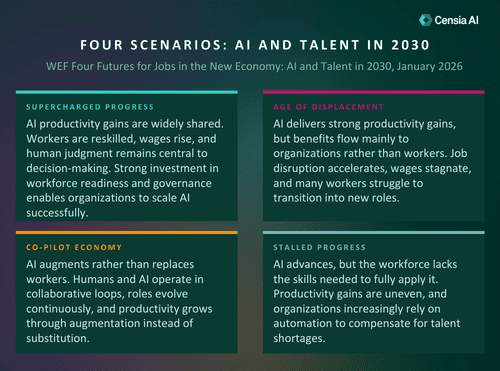
In other words, the organizations that end up in the favorable scenarios aren’t necessarily the ones that simply adopted AI tools.
That’s where the conventional approach begins to break down. When many organizations hear “workforce readiness,” they immediately think of training—upskilling programs, AI literacy courses, or new investments in learning platforms. Those initiatives absolutely matter. But they all rest on a critical assumption: that you already know where the gaps are.
For most organizations, that assumption doesn’t hold. You can’t develop capabilities you can’t see. You can’t redeploy people if you don’t know what they’re capable of beyond their current job title. You can’t build a workforce strategy around skills if your understanding of those skills is based on self-reported profiles that a majority of employees never completed.
Visibility means you know the skills your people hold today, how those skills are evolving, and where they begin to combine into new capabilities. Only then can AI initiatives be meaningfully embedded into roles and workflows in ways that deliver real business outcomes.
Workforce readiness in AI isn’t a training problem. It’s a skills visibility problem.
The Three Questions That Define Whether You’re Ready
Readiness, as an organizational capability, requires answering three questions:
1. Do you know what your people can actually do?
Not what their job titles say. Not what they self-reported three years ago. What they can actually do, based on the full arc of their careers, the skills they’ve built across roles, and the adjacent capabilities they carry that never made it into a job description. Most organizations have invested in skills taxonomies and frameworks, but the skills are not linked to the people or jobs in the organization. The result: beautifully structured skills architectures with nobody in them. You need to be able to analyze your workforce by skills, not headcount, to make real decisions about restructuring and redeployment.
2. Can you see where capabilities are shifting before the gap becomes a crisis?
When the WEF says 40% of skills will change by 2030, your hiring plans, succession pipelines, and development programs are at risk of being built on job descriptions that no longer reflect the work being done. The organizations ahead of this aren’t waiting for annual workforce planning cycles to catch up. They’re using talent intelligence to track which skills are emerging, which are declining, and which roles are fragmenting in real time. They can surface non-obvious candidates who could transition into hard-to-fill roles with minimal upskilling because the adjacent skills are already there.
3. Can you connect individual capability to organizational strategy?
This is where the gap between a skills taxonomy and real workforce intelligence becomes most visible. A taxonomy tells you that “data analysis” is a skill your organization values. AI-powered insight tells you that 340 people across six business units carry that skill at varying proficiency levels, that 45 of them have adjacent capabilities in machine learning, and that 12 of them are in roles with high attrition risk. That’s the connection between individual skills and organizational readiness. Without it, workforce strategy stays abstract. With it, HR can walk into a board meeting with an actual answer to the question, “are we ready?”
The Window Is Now
The WEF’s four futures framework makes one thing clear: the organizations that end up in the favorable scenarios aren’t the ones that adopted AI fastest. They’re the ones that invested in workforce readiness alongside adoption of AI tools. And readiness starts with being able to see what you have.
Most organizations are making workforce decisions today with job profiles built for work that no longer exists and skills inventories that reflect what people claimed, not what they can do. That gap between the workforce you think you have and the workforce you actually have is the single biggest risk in any AI transformation strategy.
Turn workforce intelligence into action. Censia helps you gain a clearer view of workforce capability, identify where critical skills already exist, and align talent decisions to business strategy. Contact sales@censia.com to get started.