

The organizations that pull ahead on workforce planning will share one advantage: job profiles that stay current with the business. Here's how to build that foundation.
By Jillian Ogawa, Head of Content Marketing, Censia | Article Published: March 27, 2026
At a glance:
-
Job profiles are workforce infrastructure, not HR housekeeping. Every workforce planning model, skills gap analysis, and development investment runs on the accuracy of your job architecture. When that layer is stale, every decision inherits the gap.
-
AI can close the maintenance gap, but explainability is the condition that makes it work. HR leaders need to understand, validate, and defend every AI-driven recommendation. A recommendation without clear rationale is not workforce intelligence.
-
When job architecture is current and explainable, the downstream effects compound. Workforce planning models sharpen. Skills gap analyses surface real gaps. Internal mobility becomes a navigable landscape. This is the shift from reactive workforce management to proactive talent intelligence.
The organizations navigating workforce change most effectively right now share one thing: they can see their workforce in motion. They know which roles are evolving, which capabilities are emerging, and where their talent is ready to move before the window closes, not after.
That clarity starts in a place most organizations haven’t looked closely enough: the job profiles sitting inside their systems right now.
Job architecture is the data layer every workforce decision runs on
Think about the range of decisions that trace back to job profiles. Workforce planning models assume them. Skills gap analysis runs against them. Development investments are scoped to them. Internal mobility surfaces opportunities through them. When those profiles are accurate, current and explainable, every decision downstream gets sharper. When they’re not, every decision inherits the same gap, often invisibly.
This isn’t a process problem. It’s a workforce intelligence infrastructure problem. Job profiles are the foundation of talent strategy the way financial data is the foundation of financial strategy. The quality of the picture determines the quality of the decisions.
The World Economic Forum “Future of Jobs Report 2025” projects that nearly 40% of workers’ existing skill sets will be transformed or become outdated by 2030. Most organizations have already felt the early pressure of that shift: roles that have changed materially, skills that have become critical without formal recognition and capabilities that have emerged in the work but not yet in the architecture. The gap between how work is actually organized and what job profiles reflect has been quietly growing, and the organizations that close it first are the ones who can plan ahead instead of catching up.
The AI workforce planning opportunity and the condition that makes it work
Keeping hundreds or thousands of job profiles current is a significant lift, and most HR teams are managing that alongside everything else. AI workforce planning tools change what’s possible here. They can surface recommended updates at a scale no manual process can match: emerging skills, shifting proficiency expectations and capabilities declining in relevance.
The more important question is what happens once the recommendations are made.
HR leaders aren’t just looking for faster job profile maintenance. They’re looking for workforce intelligence they can stand behind. A recommendation from an AI model is only as valuable as the confidence with which it can be reviewed, validated and applied. Deloitte’s “State of AI in the Enterprise” report found that 46% of organizations cite model explainability and consistency as top AI risk concerns. HR leaders feel that tension in a very specific place: the moment a job profile change has downstream consequences for planning, compensation and role design, and someone needs to explain why it was made.
Explainability is the condition under which AI recommendations become workforce decisions.
What accurate, explainable job architecture makes possible
When job profiles reflect the work and every recommended update comes with clear rationale, the downstream effects compound.
Workforce planning models stop running on outdated assumptions. Skills gap analyses surface real gaps, not artifacts of stale job descriptions. Development investments can be scoped to where work is actually heading. Internal mobility becomes more than a program. It becomes a visible, navigable landscape that employees can see themselves in.
The multiplier effect of accurate workforce architecture is this: it doesn’t just improve job profiles. It improves every talent decision that job profiles touch. Which roles are ready to evolve. Which skills gaps are forming before they become crises. Which people are positioned to move into work that’s emerging, and which investments in development will actually compound.
That’s the shift from reactive workforce management to proactive talent intelligence: not better reporting on what happened, but a clearer picture of where the workforce is heading and what it’s ready to do.
Bringing this to life inside Workday
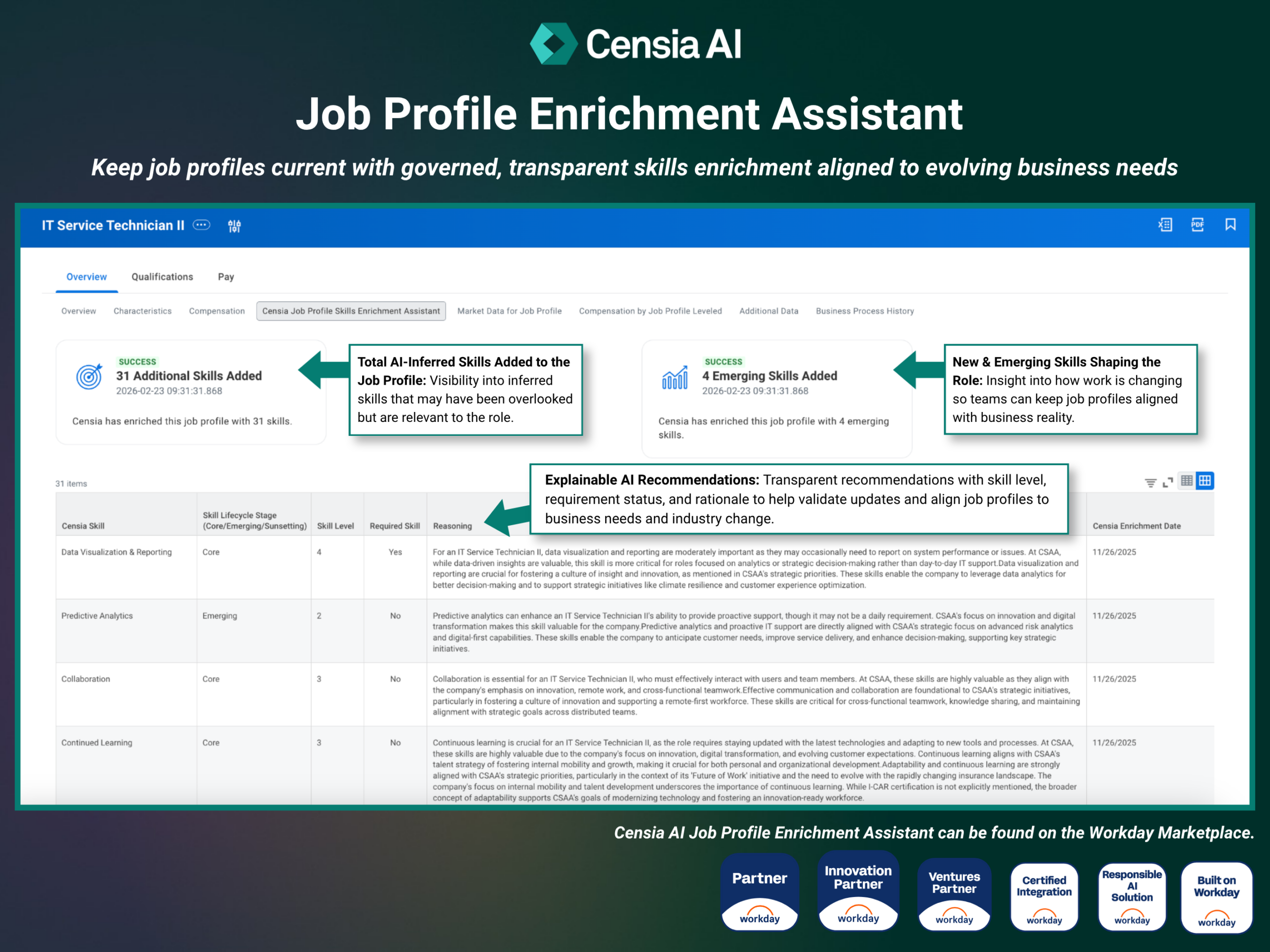
Censia AI’s Job Profile Enrichment Assistant does this work directly inside Workday. Built on Censia’s proprietary workforce intelligence models trained on nearly a decade of workforce data, the app surfaces recommended updates to job profiles where HR teams already work, with clear rationale attached to each recommendation: why the skill is suggested, how it’s categorized (core, emerging, or sunsetting) and when the analysis was performed.
Every update moves through a governed approval workflow before anything is published. Human judgment stays at the center. The result is a practical path to keeping job architecture current at scale, without trading speed for oversight.
Over time, the Assistant will expand to show where skills within a role are likely to shift, what new tasks a role might take on as work changes around it, and where responsibilities may be reshaped by AI. The goal is to give HR leaders a clearer view of job design in motion, so decisions about talent development, role structure and workforce investment are made with intention rather than in reaction.
The question worth asking now
The organizations pulling ahead on workforce strategy aren’t working harder to maintain their job profiles. They’re building the intelligence infrastructure that keeps them current automatically, and gives leaders the confidence to act on what they see.
The question isn’t whether job profiles matter. Every workforce decision you make already answers that. The question is whether yours are telling the right story about where your workforce is, and where it’s ready to go.
Censia AI’s Job Profile Enrichment Assistant is available now on the Workday Marketplace. Learn more at censia.com/workday.
Turn workforce intelligence into action. Censia helps you gain a clearer view of workforce capability, identify where critical skills already exist, and align talent decisions to business strategy. Contact sales@censia.com to get started.