
Skills-based strategy reshaped how HR thinks about people. The jobs side of the picture hasn't always kept pace. Explore why that gap is where workforce strategy stalls, and what it takes to close it.
By Jillian Ogawa, Head of Content Marketing, Censia | Article Published: April 6, 2026
At a glance:
- Why AI makes the gap urgent now: According to PwC’s Global AI Jobs Barometer, skills are changing 66% faster in AI-exposed roles. Gartner projects one in five employees will need active redeployment by 2030. Organizations making those mobility decisions with outdated job definitions are working with half the picture.
-
The gap the skills movement left behind: HR spent a decade building skills taxonomies and capability frameworks. Job architecture received less strategic investment over that same period, and the resulting asymmetry is now showing up in workforce decisions.
-
What dynamic job architecture makes possible: When job profiles are maintained with real-time labor market signals rather than updated on an annual cycle, workforce planning, internal mobility, and AI talent management recommendations all improve. This is the structural discipline that completes the skills investment most organizations have already made.
The skills movement built a real foundation for workforce strategy. But it also created a blind spot.
For a decade, HR invested in the people side: skills taxonomies, capability frameworks, skills-based hiring. Mercer’s 2025 Skills Snapshot Survey reflects that momentum, reporting growth in enterprise skills library adoption and broader skills mapping across roles.
Yet, the job side of the picture didn’t move at the same pace.
The job architecture framework that defines what roles exist, what they require, and how they connect to the work the business needs done quietly became a maintenance task—something reserved for the annual review cycle or updated only when someone had bandwidth. Job profiles stopped keeping pace with how work was actually changing.
Now AI is redistributing work at the task level, and the gap is showing. Roles that were 70% execution two years ago look different today. Capabilities that weren’t listed as formal requirements 18 months ago are now core to doing the job well. The skills data organizations spent years building is dynamic. The job definitions it gets matched against often aren’t.
That mismatch is why so many workforce intelligence initiatives are working with half the picture, and why dynamic job architecture is where workforce strategy goes next.
What “The End of Jobs” Got Right and What It Missed
“It’s the end of jobs.”
The headline that is sure to capture attention. Deloitte’s 2023 Global Human Capital Trends research gave this argument its most prominent voice, arguing that work was becoming more fluid. Projects, tasks, and cross-functional teams were replacing fixed roles, and the rigidity of the job description was a legacy artifact of an industrial era that had already passed. Skills-based hiring and capability-thinking were what organizations needed to adapt to the accelerated pace of change.
In many ways, the call for “the end of jobs” created a necessary sense of urgency. Capability-thinking does belong at the center of talent strategy. Work has genuinely become more fluid. And the job title as a proxy for what someone can do has always fallen short of what people actually do.
But the framing had a consequence that wasn’t fully anticipated: if jobs are ending, why maintain the rigor of defining them? With job architecture becoming an afterthought, job descriptions became outdated documents that nobody had time to refresh. What had once been a strategic framework quietly became a compliance exercise.
Here’s what the “end of jobs” framing missed: jobs didn’t end. They transformed. The work changed. The tasks within roles shifted. The capabilities required moved. But organizations still need a structured framework for defining what roles exist, what they require, and how they connect to the work that needs to get done. That need didn’t go away. With AI now redistributing work at the task level and AI workforce planning becoming a real operational discipline, it became more urgent than it has ever been.
Deloitte’s 2026 research puts the gap in plain terms: 59% of organizations are taking a tech-focused approach to AI, layering it onto legacy systems and processes rather than reimagining how humans and AI work together. The end-of-jobs frame didn’t eliminate job architecture as a strategic requirement. It just meant most organizations weren’t ready to do it.
What Is a Dynamic Job Architecture? A Working Definition
Dynamic job architecture—a job architecture framework that moves with the market rather than sitting static in an HRIS—has been largely absent in most enterprises. The reasons are understandable. Market signals move fast. Internal job profiles are expensive to update manually. The annual review cycle was never designed to move at the pace AI is now forcing. And for the last decade, the intellectual energy in the field was going to skills, not to jobs.
The result is an asymmetry that is now showing up in workforce decisions and AI talent management initiatives. Organizations invested meaningfully in the people side. They have the data, the taxonomy, the profiles. What many don’t have is an equally current picture of what their roles actually require. The job definitions they’re matching against often reflect work as it existed two or three years ago: before AI began redistributing tasks, before new capabilities became core requirements, before proficiency expectations in AI-exposed roles started moving at a rate the annual review cycle wasn’t built to capture.
A job profile that doesn’t reflect those shifts isn’t a description of work. It’s a historical document. And matching a rich, dynamic skills taxonomy against a historical document is the exact asymmetry that makes workforce planning feel like working with half the picture.
Why the Research Confirms the Gap and Why It Matters Now
The data makes the stakes concrete, and the numbers tell a connected story.
The PwC Global AI Jobs Barometer found that skills change is occurring 66% faster in AI-exposed roles than in others. That acceleration is already compressing the useful life of job profiles built on last year’s requirements. The WEF Future of Jobs Report 2025 puts the longer arc in context: 39% of existing skill sets will be transformed or outdated by 2030. McKinsey’s research on AI agents adds the mechanism driving that change, finding that AI agents could perform tasks occupying 44% of U.S. work hours, which means the task composition of roles is shifting faster than most job profiles are built to reflect.
The workforce planning implications follow directly. Gartner projects that one in five employees will need active redeployment through internal mobility by 2030, and that HR will redirect one third of its recruiting capacity toward internal moves. Those redeployment decisions depend on accurate role definitions. BCG’s research on AI transformation found that 70% of the value comes from people and processes rather than algorithms, which puts job architecture squarely inside the layer where most of the outcome is determined. The EY Work Reimagined Survey found that organizations are missing up to 40% of potential AI productivity gains due to gaps in talent strategy. An outdated job architecture is one of the most direct ways that gap forms.
The disruption McKinsey describes isn’t primarily about which skills become irrelevant. It’s about how skills get applied within roles: which tasks a given role still contains, which capabilities have moved to the center, and which proficiency expectations have quietly shifted. That is a job architecture problem as much as a skills problem, and it is precisely what makes AI workforce planning difficult to execute well without a current job architecture foundation.
Job profiles are the architecture that talent intelligence tools draw from when recommending internal moves, assessing readiness, surfacing gaps, and identifying who should be redeployed as work evolves. When the skills side is dynamic and the job side is static, those tools are working with an incomplete picture. The recommendations they surface are only as good as the job definitions underneath them.
Gartner projects that HR will redirect one third of its recruiting capacity toward internal mobility. The organizations without current job architecture will be making those redeployment decisions with outdated maps, at exactly the moment when the precision of those decisions matters most. BCG’s 70/20/10 framework puts the business case plainly: job architecture is the structural layer that connects skills to decisions. It sits inside the 70%, the place where most of the value either gets captured or doesn’t. McKinsey’s strategic workforce planning research found that top-performing talent organizations achieve revenue per employee roughly three times higher than their peers. The structural elements that distinguish those organizations depend on both sides of the equation being accurate.
What Dynamic Job Architecture Looks Like in Practice
This isn’t a theoretical problem. It shows up in concrete decision moments.
AI is changing what roles actually contain. Which tasks remain. Which capabilities have moved to the center. Which proficiency expectations have quietly shifted upward. The job profile sitting in your HRIS may describe work as it existed two years ago, not the work someone is being asked to do today.
Deloitte’s 2026 Global Human Capital Trends research, drawing on more than 9,000 leaders across 89 countries, found that 59% of organizations are still layering AI onto legacy structures rather than redesigning for the work they actually have. Static job architecture is the most common legacy layer in both workforce strategy and AI talent management initiatives, and it’s the one most directly exposed as AI continues to redistribute what roles contain. The organizations getting ahead aren’t necessarily the most technologically sophisticated. They’re the ones that recognized the job side of the picture needed the same continuous investment the skills movement brought to the people side.
How the Picture Becomes Complete
The answer to “the end of jobs” was never to abandon job architecture. It was to make job architecture dynamic, to build the same rigor and continuous investment on the jobs side that the skills movement brought to the people side.
That capability has been hardest to build operationally. Tracking how roles evolve in the labor market, comparing those signals to internal profiles, surfacing what has changed and why, and doing that continuously at scale was research work that never fit inside an HR team’s capacity. It happened episodically, when someone had bandwidth, which meant it mostly didn’t happen at the pace the work was changing.
Closing that gap requires more than better data. It requires a system that can continuously track how roles are evolving in the labor market, surface what has shifted and why, and do that at a pace and scale that no HR team can sustain manually. It also requires transparency: HR leaders need to understand the reasoning behind every recommended change, not just receive a list of updates to approve. That combination—continuous intelligence, clear rationale, and governed human oversight—is precisely what has been hardest to build operationally.
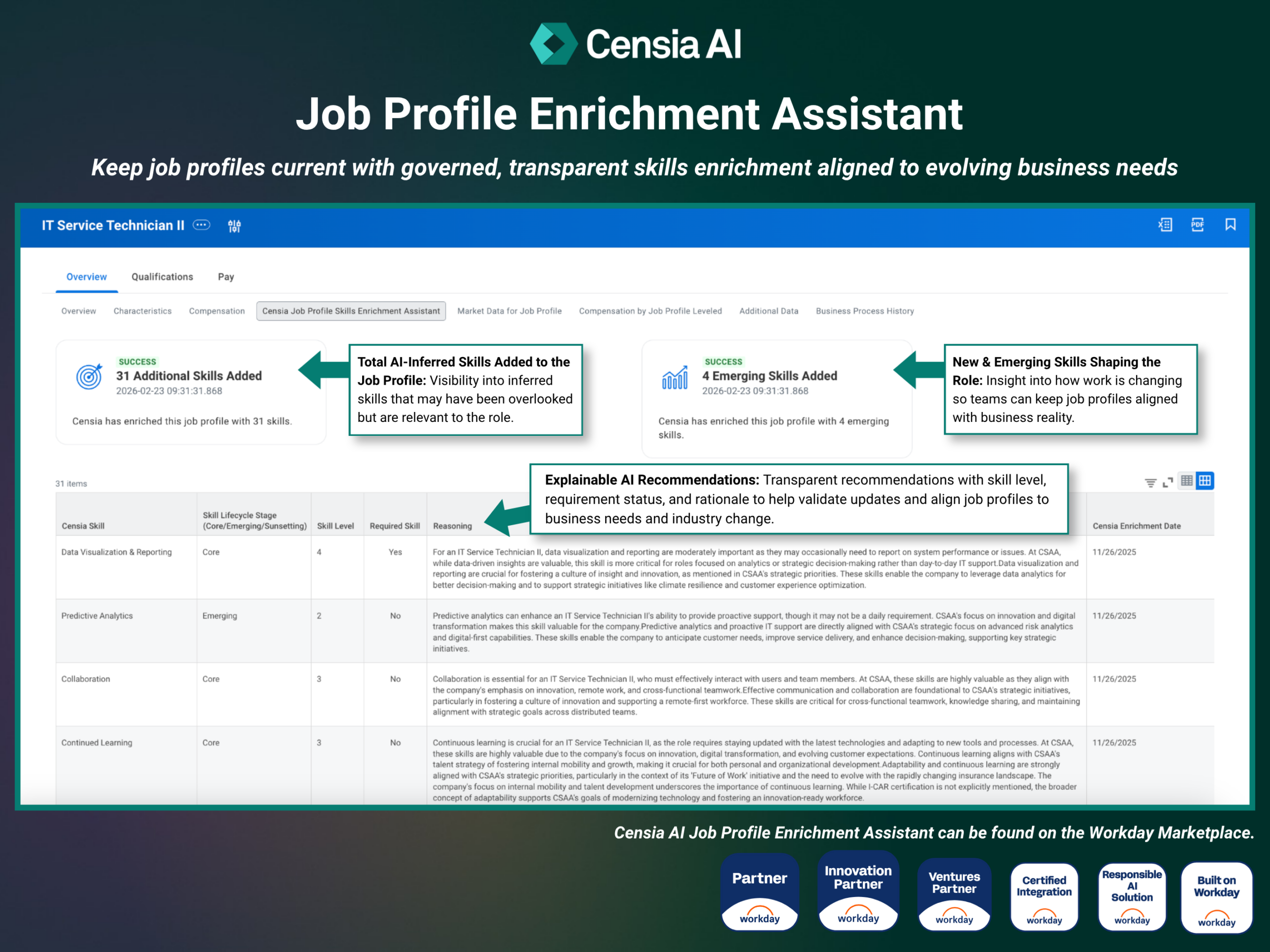
That is what Censia AI built, inside Workday. The Job Profile Enrichment Assistant, available now on the Workday Marketplace, surfaces recommended updates to job profiles directly inside the Workday interface: emerging skills, shifting proficiency expectations, and capabilities declining in relevance. Every recommendation includes the reasoning behind it—why the skill is suggested, how it is categorized as core, emerging, or sunsetting, and when the analysis was performed—so HR teams can review and validate with confidence rather than defer or delay. Updates route through a governed approval workflow built with Workday Extend before anything is published, keeping human judgment at the center of every decision.
The result is a practical answer to the asymmetry this piece has been building toward. The people side and the jobs side, both current, both contextual, both drawing from the same workforce intelligence infrastructure. As Joanna Riley, CEO of Censia, put it at launch: “HR leaders are watching roles change faster than their job architecture can keep up, and most are making workforce decisions without the context to explain why.” The Job Profile Enrichment Assistant is built for exactly that moment.
The Next Chapter
Deloitte was right that the job as a rigid, static unit of work was limiting organizations. The skills movement was right to build something richer on the people side: the skills taxonomies, the skills-based hiring frameworks, the talent intelligence infrastructure that now underpins modern workforce decisions.
What comes next is bringing the same discipline to the job side. Not the end of jobs. The active, ongoing architecture of them, kept current, matched against a labor market moving faster than it ever has, and connected to the workforce picture organizations have spent years building.
The skills chapter was the right first move. Job architecture is what makes it complete.
Frequently Asked Questions About Job Architecture
What is job architecture in HR?
Job architecture is the framework that defines how roles are structured within an organization, including the skills each role requires, the levels it represents, and how it maps to the work the business needs done. Unlike a job description, which captures a point-in-time snapshot, a job architecture framework is ideally a living system that evolves as work changes. It reflects current market requirements, updated proficiency expectations, and emerging capabilities. In AI talent management, job architecture functions as the structural data layer that talent intelligence tools draw from when making recommendations.
What is dynamic job architecture?
Dynamic job architecture refers to job profiles that are actively maintained using real-time labor market signals, rather than treated as static documents. In a static model, job profiles are updated on an annual cycle or less. In a dynamic model, job profiles reflect emerging skills requirements, shifting proficiency expectations, and capabilities declining in relevance, with updates driven by AI analysis of live job market data. This is the operational evolution of the static job architecture frameworks most organizations built during the skills-based hiring movement.
Why is job architecture important for workforce planning and internal mobility?
Workforce planning tools and internal mobility platforms draw directly from job architecture. When job profiles are outdated, the recommendations those systems surface are only as accurate as the definitions underneath them. Gartner projects that one in five employees will need active redeployment by 2030 and that HR will redirect one third of its recruiting capacity toward internal mobility. Organizations without current, dynamic job architecture will be making those redeployment decisions with outdated role definitions, at exactly the moment when precision matters most.
How does AI affect job architecture and skills taxonomies?
AI is redistributing work at the task level, changing which tasks a given role contains, which capabilities are now core, and which proficiency expectations have shifted. PwC’s Global AI Jobs Barometer found skills change is occurring 66% faster in AI-exposed roles. This means job profiles become outdated faster than at any prior point, and maintaining an accurate job architecture framework requires continuous market signal monitoring. Skills taxonomies face the same pressure: the skills that defined roles two years ago may have moved from primary to secondary requirements as AI capabilities absorb specific task clusters.
What is the difference between talent intelligence and skills intelligence?
Skills intelligence focuses specifically on understanding workforce capabilities: what skills employees have, how they were developed, and what they signal about potential. Talent intelligence is broader. It encompasses skills intelligence on the people side and job intelligence on the roles side, synthesized into actionable workforce decisions. The distinction matters because skills intelligence alone, without an equally current picture of what roles require, produces recommendations that are only half as accurate as they could be. Both sides of the equation need to be current for talent intelligence to function as a true decision-making infrastructure.
What is workforce intelligence and how does it relate to job architecture?
Workforce intelligence is the capability to translate workforce data into actionable decisions across hiring, mobility, planning, and organizational design. Job architecture is the structural foundation that workforce intelligence tools draw from. When job profiles are current and contextually rich, workforce intelligence recommendations improve in accuracy and specificity. When job architecture is static or outdated, even sophisticated workforce intelligence platforms are working with an incomplete picture of what the organization’s roles actually require.
Turn workforce intelligence into action. Censia helps you gain a clearer view of workforce capability, identify where critical skills already exist, and align talent decisions to business strategy. Contact sales@censia.com to get started.